Bonsay Brush: A Chic Script Font for Elegant Branding
It was 3 a.m., and I was staring at a half-finished label design for my friend’s small-batch lavender candle line—her first wholesale order due in 48 hours. She’d sent over her handwritten logo sketch, but the digital version felt flat, generic, even a little tired. She needed something that whispered “hand-poured,” “thoughtfully made,” and “quiet luxury”—not “mass-produced font from a free download site.” That’s when I opened my fonts folder, scrolled past the usual suspects, and landed on Bonsay Brush. Within minutes, her candle jar label had warmth, rhythm, and intention. That’s the quiet power of a truly well-crafted Script Handwritten font.
Bonsay Brush for Product Labels and Handmade Packaging
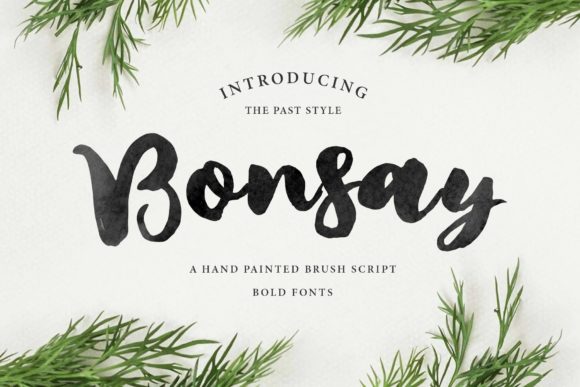
Bonsay Brush isn’t just another decorative script—it’s a Fonts choice built for moments where texture and personality matter most. Think: the delicate serif-like taper of its lowercase “e,” the graceful entry and exit strokes that mimic real ink flow, or how each letter leans just slightly forward, like it’s leaning in to share a secret. It’s this subtle humanity that makes Bonsay Brush ideal for product labels—especially for makers who hand-pour, hand-stitch, or hand-blend. I’ve used it on matte sticker labels for ceramic mugs, embossed foil stamping on kraft soap boxes, and even laser-etched wooden tags for botanical skincare. Because Bonsay Brush is intentionally light in contrast and airy in spacing, it breathes beautifully on small surfaces—no crowding, no visual noise. Just elegance, legible at 10 pt on a 2-inch label, and effortlessly upscale.
Bonsay Brush for Café Menus and Printed Brand Materials
When your café menu is printed on textured paper and pinned to a reclaimed wood board, typography does more than list items—it sets mood, pace, and expectation. That’s where Bonsay Brush shines as a Script Handwritten display font: it adds softness without sacrificing clarity. I recently helped a neighborhood espresso bar refresh their seasonal menu using Bonsay Brush for dish names (“Honey Lavender Latte,” “Sourdough & Burrata Toast”) paired with a clean, warm sans serif (like Montserrat Light) for descriptions and prices. The result? A menu that feels curated—not clinical. Customers linger longer. Baristas say guests comment on the “pretty writing.” And yes—it’s fully readable under cafe lighting and at arm’s length. Pro tip: use Bonsay Brush only for short, high-impact phrases—never body copy. Its charm lives in brevity, not paragraphs.
Bonsay Brush for Social Media Graphics and Instagram Templates
If you’ve ever tried to make a Canva story feel *yours*—not just “on-brand” but *emotionally resonant*—you know how hard it is to find a script that looks handmade without looking messy. Bonsay Brush bridges that gap. As a Fonts option for social media graphics, it delivers consistency across platforms: the same gentle curve on your Instagram highlight cover, your Pinterest pin title, and your Etsy shop banner. Because it’s a true Script Handwritten typeface—not a scanned signature or a wobbly brush effect—it scales cleanly on mobile screens and renders crisply in digital ads. I use it exclusively for headline text in templates: “New Arrivals,” “Join Our Circle,” “Limited Edition Drop.” Paired with a neutral sans serif for captions and CTAs, it creates hierarchy that feels intuitive, not forced.
Bonsay Brush for Thank-You Cards and Customer-Facing Touchpoints
There’s a reason handwritten notes outsell digital ones in small business: they signal care. Bonsay Brush brings that sincerity into print—without requiring actual handwriting. When used on thank-you cards, packaging inserts, or even email subject lines (yes, it works in web-safe fallbacks), it communicates warmth and attention to detail. What surprised me most was how naturally Bonsay Brush pairs with classic serif fonts like Playfair Display or modern sans serifs like Poppins. No clashing. No over-designing. Just harmony. And because it includes standard OpenType features—ligatures, stylistic alternates, and multilingual support—it adapts gracefully whether you’re labeling a candle for a local boutique or designing a bilingual gift tag for an online shop. Just double-check licensing before using Bonsay Brush on physical products or client deliverables—it’s a commercial font, and that peace of mind matters.
Bonsay Brush for Logo Design and Brand Identity Systems
Let’s be clear: Bonsay Brush is not a workhorse font for long paragraphs or data tables. But as a Script Handwritten anchor for logo design? Absolutely. It’s got the grace of a calligrapher and the restraint of a designer. I’ve seen it become the centerpiece of a floral studio’s monogram, the elegant accent beside a minimalist wordmark for a herbal tea brand, and the sole typographic element for a boutique’s woven linen tag. Its strength lies in memorability—not complexity. When customers see that distinctive “g” or the looping “y” again—on a website banner, a sticker, a receipt—they recognize it. That’s brand consistency, built one thoughtful Fonts choice at a time. And because Bonsay Brush was crafted for beauty *and* usability, it doesn’t sacrifice legibility for flair. It earns its place—not just decorates it.